Reading and categorising enquiries
An email with travel dates and wishes is easy for a language model to understand. 40 enquiries a week become 40 prepared offers. The win is in response time, not in headcount.

Many hotel chains are already using AI. What is often missing is a shared direction, clear responsibilities and clean integrations. That is where isolated tools, unnecessary risks and team frustration appear.1
1 The global h2c study shows: 78 percent of surveyed hotel chains use AI, but only 7 percent have a company-wide AI strategy. 189 people from 171 hotel chains worldwide were surveyed. Source: h2c, AI & Automation in Hospitality, 2025. Read the study
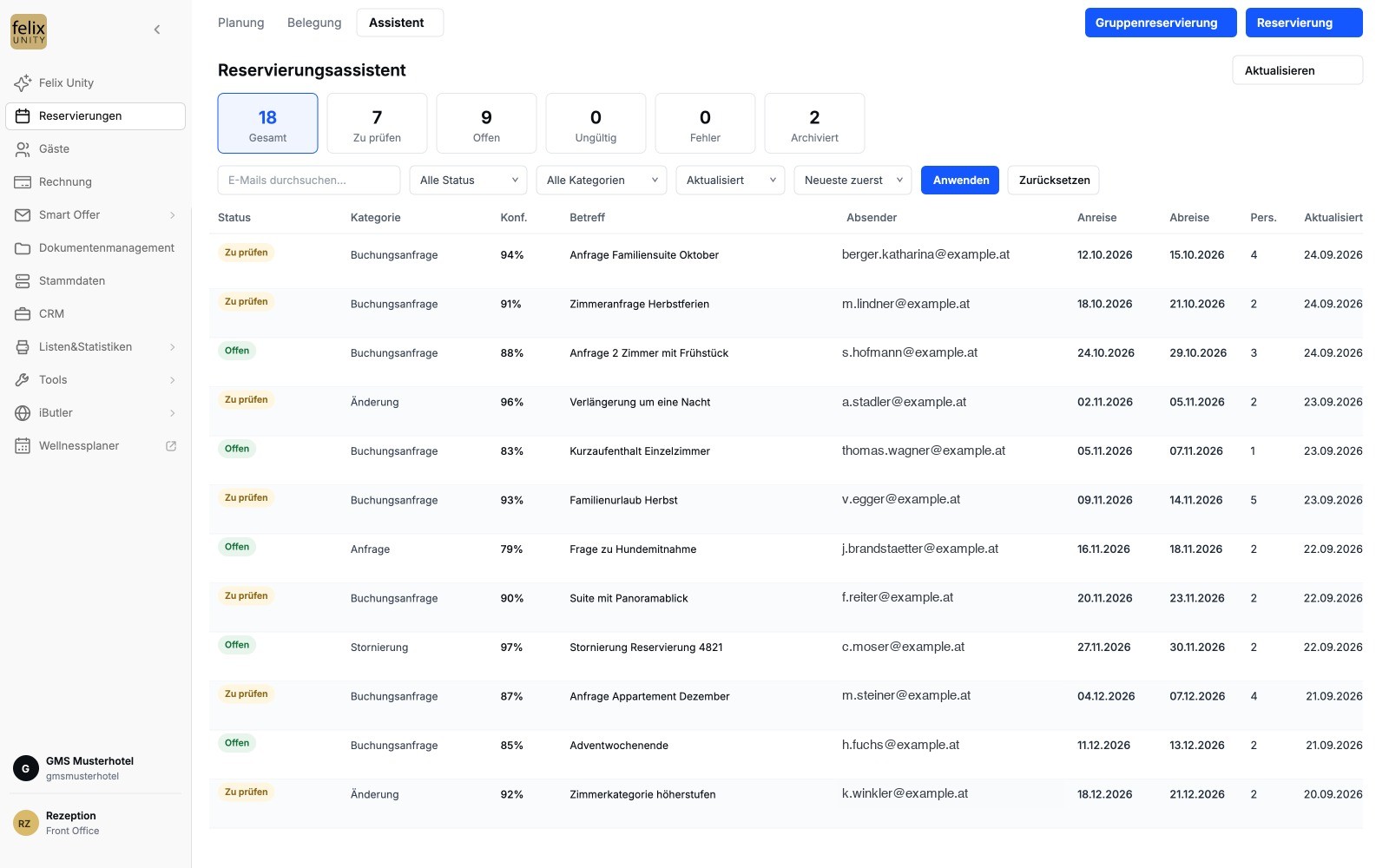
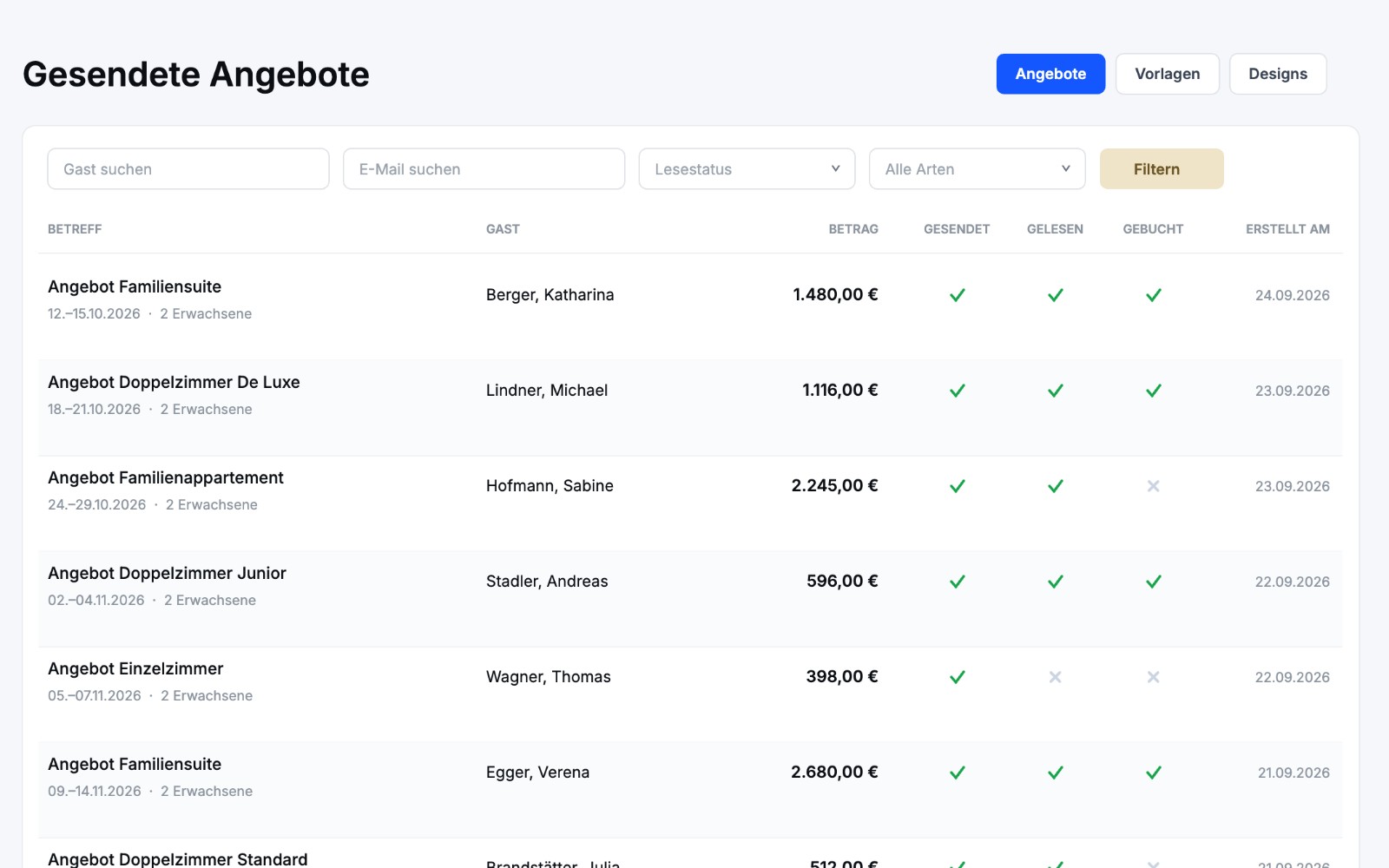
In six places very clearly. What they share: a lot of repetition, clear rules, a verifiable result.
An email with travel dates and wishes is easy for a language model to understand. 40 enquiries a week become 40 prepared offers. The win is in response time, not in headcount.
Confirmations, reminders and replies in six languages, in the house's tone. What used to be a cost centre is now a setting.
Occupancy curves, cancellation rates, source markets. AI spots anomalies in data you already have, before they show up in the monthly report.
Room status, task allocation, official reporting. Wherever someone works through a list today, a system can make the start and leave the decisions to people.
House rules, packages, agreements with regulars. New staff find answers without interrupting someone who is with a guest.
An arrival check that flags what is missing before the shift starts: registration forms, room allocation, bed configuration for families. A small thing, every day.
You rarely hear these six points from vendors, but they decide whether a project holds up.
AI does not turn a messy dataset into a clean one. It just distributes it faster. Inconsistent room categories and duplicate guest profiles become serial errors instead of being caught.
A system can write an offer. Whether this regular guest gets a discount this year is still a human call. Forcing automation where judgement is needed loses guests.
Language models answer smoothly even when the ground is thin. Without a visible data snapshot and a confidence score, nobody in operations notices. Ask every vendor how they solve this.
Every model request costs money. Without a quota, a usage display and a hard cap, a predictable line item turns into an open invoice. The most common nasty letter after the first quarter.
A receptionist who feels replaced will not use the tool. One who sees the tedious twenty morning minutes disappear, will. That is a change-management issue, not a technical one.
If the automation rules only live in the vendor's system and cannot be exported, a later switch is expensive. Ask about export formats and timelines before signing.
The term is now on almost every vendor's page. It has, however, a testable meaning.
AI-native means: AI is the way the software is operated. It is not an add-on beside the actual product. Data model, permissions, protocol and interface are built so that the system prepares and the human decides.
The counterpart is called bolted on in the trade: an existing piece of software with a chat window added on top. There, the chat talks to the user, but not to the system.
The simplest test
Imagine every AI function taken away. What is left?
If the product looks the same as before, AI was bolted on. If the operation shifts to where menus and clicks used to be, it is AI-native. The test costs nothing and shows more than any sales pitch.
Take this list into your next vendor meeting. You do not need IT skills for it.
The EU AI Act assigns duties depending on your role. For hotels, the main ones are a clearly labelled guest chat, trained staff and an auditable use of AI.
Whenever a guest communicates with a chatbot, a digital concierge or an AI-generated reply, they must be able to recognise this. The transparency obligations apply in full from 2 August 2026. Breaches are subject to sanctions.
Businesses that deploy AI must ensure their staff have sufficient AI competence. A short, documented briefing therefore belongs to onboarding.
For guest data you are the controller, not the vendor. You need a data processing agreement, and for high-risk processing a data protection impact assessment.
2 European Commission, EU AI Act: transparency obligations under Article 50 apply from 02.08.2026. The obligation to ensure sufficient AI literacy under Article 4 applies from 02.02.2025. Which duties apply to your hotel depends on the system and your role. European Commission guidance
This page is not a substitute for legal advice. It names the obligations most often overlooked in practice.
The same seven questions, applied to us. You are free to verify each of them in the demo.
| The question | Our answer |
|---|---|
| Does the AI live in a drawer? | felix is how you operate the system, not a window next to it. You write or speak in plain sentences and things happen in the system. The classic views stay alongside. |
| Does it only know one area? | Reservations, offers, housekeeping, official reporting and analytics sit on one dataset. Plus over 400 integrations from 46 years of felix. |
| Does it only talk? | It creates offers, distributes tasks, generates lists and notifications. What it may execute is up to you. |
| Does it show a data snapshot and confidence? | Yes. Every check shows the timestamp, the data snapshot and the areas covered; incoming enquiries carry a confidence score. |
| Are approvals configurable? | Yes, per workflow and per role. You move the boundary in either direction at any time. |
| Is AI usage visible? | Monthly quota, usage visible before triggering, hard cap as default, warning at 70, 90 and 100 percent. |
| And the guest data? | Storage and processing on European servers only. Model training happens without your guest data. |
felixUnity is launching together with selected businesses. We do not yet have reliable impact numbers from live operations. We will publish them once they exist. And not before.
All test questions in the comparisonIn practice, it shifts the work rather than replacing it. What disappears is the typing, looking up and forwarding. What remains is the part guests come back for.
Not across the whole property, but in the starting area. A sensible project begins with a single workflow, so the dataset can be brought into shape in a manageable time.
Yes. Since 2 August 2026, the transparency obligations of the EU AI Act apply in full, also to chatbots and AI-supported communication. The disclosure must be recognisable for the guest.
Not at felixUnity. Storage and processing take place on European servers only, and model training happens without your guest data. Ask every vendor to confirm this in writing.
What matters is the structure: a monthly quota, visible usage and a hard cap as the default. Without these three things, planning is impossible.
Bring a real enquiry from your hotel. We go through it together, and you ask the seven questions from this page.